girls’ last tour and writing co-protagonists
I love Girls’ Last Tour.
Besides the obvious fact that I’m currently trying to copy it page by page, panel by panel, it’s an anime that’s been with me for most of my journey as an artist, guiding my tastes both in experiencing and creating. I’ve rewatched it countless times, each time breaking down different details, or sometimes just enjoying the coziness. Last semester, I wrote a piece on Chito and Yuuri and their narrative function as co-protagonists, to figure out what makes them tick, and hopefully be able to apply it to my own work.
It’s important to state a few relevant things about the narrative of Girls’ Last Tour. At its core, it’s an exceedingly simple narrative: a journey to the top floor of the city – and a journey which is long, but not harduous. Because of this extremely simple framing for the entire narrative, there is very little space for plot to take over, lending most of the narrative space to the characters themselves – the travellers – and their own internal and interpersonal worlds.
Chito and Yuuri work together not only in the sense that they both want to reach the top floor of the city, but they both want it for the same reason, as they believe that, once at the top, they’ll find their place in this desolate and abandoned world. However, the two characters still define themselves in their contrasts – Chito’s restraint, rigidity of thought and obcessive worry to Yuuri’s carelessness, open-mindedness and spontaneity, Chito’s love of the past to Yuuri’s love of the present, Chito’s intellectual and narrative memory to Yuuri’s sensory memory. Chito and Yuuri are narratively aligned – they share the same external and internal arcs- but are personally contrasting – and often react in opposing ways to the same challenges. Despite that, the two act as one, in a way that seems to echo the concept of two voices of a singular conscience.
This complementary relationship of theirs is challenged at multiple points in the narrative, either by threatening separation, forcing it, or posing the question through encounters with other travellers. Kanazawa, one of the people they encounter, lost his complement – his partner. He wanders the world alone, carrying the memories of her on his camera and in his maps, a sort of echo of the search he seems to endlessly continue. Ishii has no complement, so when her work comes crumbling down, she embraces hopelessness alone, knowing there’ll be noone there for her.
Through their similarities and their differences, their unity and complementarity, highlighted primarily in the moments of separation, the narrative builds a very intimate and strong bond between Chito and Yuuri, leading us to conclude, once they do reach the top floor of the city, that they realize they weren’t trying to find their place in the world afterall, but simply struggling to recognize that they already had it – beside eachother.
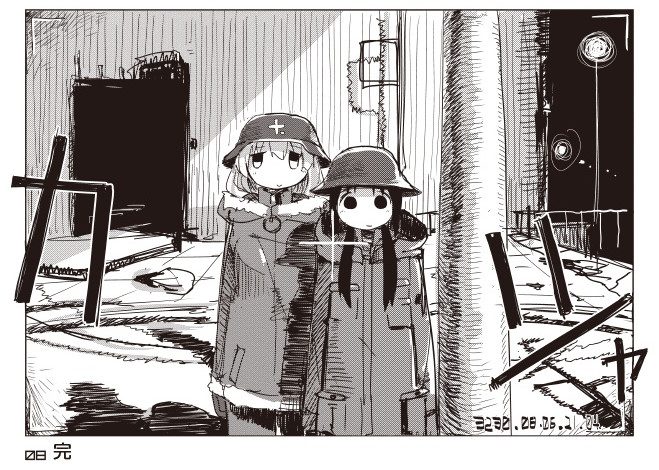 Until recently, I hadn’t made this connection, but once it was pointed out to me it became increasingly clear that this kind of narrative is one that draws me in incredibly well. I find a lot to relate in these long, not materially difficult but extremely introspective journeys, and it probably has something to do with my own relation with my constant struggle and search for identity and belonging. It’s a note to look to when creating my future work.
This is a good starting point.